
The SPLC Thread: Pulling Apart the Fourth Branch | PART I The Indictment and the Architecture

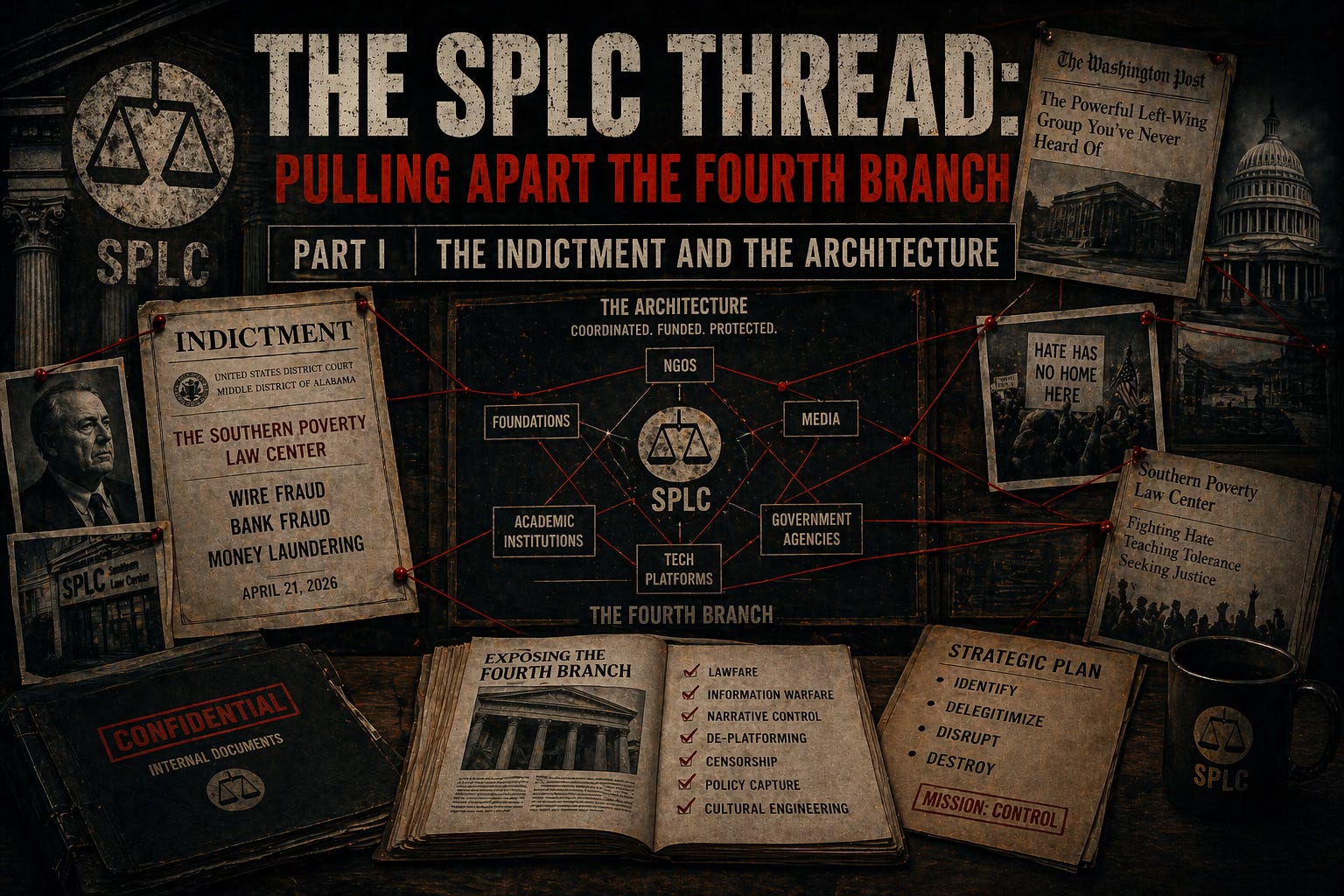
On April 21, 2026, a federal grand jury in Montgomery, Alabama charged the most famous civil-rights nonprofit in the United States with wire fraud, bank fraud, and money laundering. That indictment is not the story. It is the thread. And when pulled, it will not unravel a nonprofit. It will unravel the fourth unelected branch of American government.
By Tore · April 24, 2026 · Part I of VII
Before any of this can be understood, one premise must be fixed in the mind: this is not a story about a civil-rights nonprofit’s legal troubles. It is a story about how American civil society was reorganized, over fifty years, into something that operates like a distributed fourth branch of government — one that makes policy, writes designations, directs enforcement, and shapes public opinion, while answering to no voter. The Southern Poverty Law Center is not the subject of this series. It is the thread. And the thread, when pulled with the right amount of tension in the right direction, unravels the whole garment.
The indictment was unsealed on Tuesday, April 21, 2026, in the United States District Court for the Middle District of Alabama. An eleven-count document returned by a grand jury of Alabamians charged the Southern Poverty Law Center — an organization headquartered in Montgomery since its founding in 1971, an organization that for most of its public life has been treated by mainstream American media as the authoritative arbiter of who does and does not deserve to be called a hate group — with six counts of wire fraud, four counts of bank fraud, and one count of conspiracy to commit concealment money laundering.
Acting Attorney General Todd Blanche announced the charges at the Justice Department flanked by FBI Director Kash Patel. More than three million dollars in donations, Blanche alleged, had been paid between 2014 and 2023 to individuals affiliated with the Ku Klux Klan, the United Klans of America, the National Socialist Party of America, the Aryan Nations, and the neo-Nazi National Alliance. To disguise the payments, prosecutors said, the SPLC had opened bank accounts under the names of fictitious entities — one called “Fox Photography,” another called “Rare Books Warehouse” — and had routed donor money through them while concealing the program’s existence from the donors whose small-dollar contributions funded it.
One of the informants, according to the indictment, was a member of the online leadership chat group that planned the August 2017 “Unite the Right” rally in Charlottesville. He attended the rally at the direction of the SPLC. He helped coordinate transportation for several of the attendees. He was paid more than two hundred and seventy thousand dollars between 2015 and 2023. Another informant was paid more than one million dollars over roughly the same period while actively affiliated with the neo-Nazi National Alliance.
The SPLC has denied wrongdoing. Its interim president, Bryan Fair — a constitutional law professor at the University of Alabama who stepped up from board chair after Margaret Huang’s exit in July 2025 — released a statement calling the allegations false, saying the informant program “saved lives,” and promising a vigorous defense. The defense may well succeed. A retired federal judge has already told CNN that the case faces serious legal obstacles. Donors, she suggested, understood in general terms that SPLC existed to infiltrate and weaken extremist groups, and the theory that SPLC defrauded them by doing precisely that is an ambitious one for a criminal prosecution.
This series is not about whether the SPLC’s lawyers will win at trial. That is a question for the court and for Judge Emily Marks, a Trump appointee to whom the case has been assigned. This series is about what the indictment makes possible — what it puts into federal discovery, what documents it forces into the public record, and what a careful reading of those documents reveals about a larger architecture the SPLC has been, for forty years, one of several central nodes inside.
I. Before We Begin — What This Series Is Not
It is important to say, at the outset and in plain English, what this series is not.
This is not a series that argues paid confidential informants inside extremist movements are illegitimate. They are not. The FBI has used paid informants inside the Klan, the Aryan Nations, the Proud Boys, and sovereign-citizen networks for decades. Academic researchers have conducted paid interviews with active extremists and produced some of the most important scholarship on American radicalization. Civil-society monitoring organizations have, in the aftermath of lethal events, sometimes been the only institutional check between ordinary citizens and the formations that plotted their deaths. The question the SPLC indictment poses is narrower. It is whether a 501(c)(3) can use undisclosed donor money, passed through shell LLCs it opened under materially false representations to federally insured banks, to pay a source who is actively helping plan a violent rally rather than merely reporting on it. That narrower question has narrower answers, and the answers do not collapse into “SPLC was doing what the FBI does.” SPLC is not the FBI. It has no legal authorities, no DOJ guidelines, no congressional oversight, and no inspector general. The gap between what the FBI can do and what SPLC did is the gap the indictment lives in.
This is also not a series that denies the political context of the prosecution. The Justice Department that returned the indictment is Donald Trump’s. The acting attorney general is Todd Blanche, who was Trump’s personal defense lawyer. The FBI director is Kash Patel, who severed the Bureau’s forty-year relationship with SPLC six months before the case came down. The SPLC’s defenders will call this retaliation. Some of them will have reasons to believe it. An honest series does not wave that away. What an honest series does is distinguish between two questions that are easily confused. One: did the underlying conduct happen? Two: is the prosecution motivated by a political grudge? These questions are not identical. The Maajid Nawaz $3.375 million settlement happened under Obama’s second term. The Cayman Islands financial account appears on an SPLC Form 990 filed with the IRS during the Biden administration. The 2019 employee petition demanding an investigation of Morris Dees was written by SPLC’s own employees. None of these facts required Donald Trump to surface them. They surfaced because of the accumulating pressure of their own reality.
And this is not a series that argues the American political right is blameless in the rise of the ecosystem this series is about. Dark-money infrastructure exists on both sides. Leonard Leo’s network is real. DonorsTrust is real. The Federalist Society has its own influence apparatus. The difference is one of scale, integration, and constitutional function. A conservative litigation shop that sues the federal government over regulatory overreach is doing what private citizens and their lawyers have always done. An integrated network of 501(c)(3)s and 501(c)(4)s that produces designations, feeds them into federal enforcement agencies, sues elected state officials over the administration of elections, and funds all of it through opaque pass-through vehicles whose retail donation conduit is now under federal criminal investigation for foreign-money exposure — that is a different thing. It is the first form of power that has ever existed in the United States which performs governmental functions without being accountable to government’s constitutional correctives.
To be clear. This series will acknowledge counterarguments directly, in each installment, where they arise. The fact that SPLC did real civil-rights work against actual Klan violence in the 1980s does not neutralize what the organization did in the 2020s, any more than the fact that the 1995 Montgomery Advertiser series documented financial self-dealing means everything SPLC ever published was false. Institutions can do legitimate work and corrupt work in the same decade. The task of serious investigation is to distinguish between them, not to collapse them.
What this series does argue is that the pattern documented across the next six installments is not a story about one bad nonprofit. It is a story about how the American constitutional order — three elected branches, with a civil sector understood as citizens organizing themselves voluntarily to pursue shared ends — has quietly been reorganized so that a fourth structure performs the functions of government without any of the government’s accountability mechanisms. The SPLC indictment is the first legal instrument that can compel disclosure of how that structure actually connects.
II. The Fourth Branch — A Distributed Agency
Americans are taught three branches of government. Legislative, executive, judicial. The three make the law, enforce the law, and interpret the law. Each is accountable — Congress through elections every two and six years, the executive through elections every four, the judiciary through appointments made by the elected and confirmations given by the elected. This is the constitutional design. It is also, increasingly, a description of how the country is governed in form only.
The real machinery of American governance in 2026 operates in substantial part through a structure that does not appear in the Constitution. It consists of six layers, each of which looks, in isolation, like something else. Put together, the layers operate as a functionally integrated fourth branch.
THE FOURTH BRANCH — SIX LAYERS
LayerWhat It DoesThe DesignatorsSPLC, ADL, Leadership Conference, NAACP-LDF. The organizations that tell federal, state, and corporate America which groups and individuals count as threats, which speech counts as hate, and which political formations count as extremist.The Enforcement InterfaceFBI, DHS, NSC, Treasury-OFAC, State-DRL, DOJ Civil Rights Division. The federal agencies that ingest designations as intelligence product, translate them into enforcement priorities, and direct the actual coercive machinery of the state.The Litigation ArmElias Law Group, Perkins Coie, ACLU, NAACP-LDF, Democracy Docket. The lawyers who translate designations into court orders that override elected legislatures, elected secretaries of state, and the separately enumerated constitutional powers of the states.The Money PlumbingOSI, Ford, Rockefeller, Hewlett, Arabella Advisors’ four-fund cluster (New Venture, Hopewell, Sixteen Thirty, Windward), ActBlue Charities. The philanthropies, dark-money pass-throughs, and retail donation conduits that keep the apparatus funded.The Academic Source CodeHarvard Ash Center, Wilson Center, Sié Center at Denver, Carr Center, Belfer Center, PRIO Oslo, ICNC, One Earth Future. The university-housed institutes that produce the doctrine — civil-resistance theory, disinformation studies, the “Democracy Playbook” — that justifies the operations.The Media AmplifiersThe New York Times, the Washington Post, The Atlantic, ProPublica, the op-ed columnists and the nonprofit newsrooms that translate designations into public narrative and treat the designators as neutral sources.
Each of these layers, taken by itself, looks unobjectionable. Civic organizations have a First Amendment right to classify anything they want. Federal agencies have the authority to use outside expertise. Lawyers have the right to bring cases. Donors have the right to give. Universities have the right to teach. Newspapers have the right to cover what interests their editors. No individual layer is, in its own operation, a usurpation of constitutional authority.
What the fourth-branch problem describes is a different and harder thing. It is what happens when the layers are not independent — when the designators are staffed by people who previously worked in the enforcement interface, funded by the money plumbing that also funds the litigation arm, schooled in the doctrine produced by the academic source code, and covered by the media amplifiers as if they were neutral arbiters of the very designations they are paid to produce. That is not civil society. That is an integrated policy apparatus. And when it reaches a scale at which its decisions functionally override elected legislatures, elected governors, elected county boards, and elected secretaries of state, it has stopped being civil society and started being a fourth branch — a branch whose only constitutional correction mechanism is the election of an executive branch willing to investigate and prosecute it.
Which is what happened, twice, in the twelve months preceding April 21, 2026. The first time was October 2025, when FBI Director Patel severed ties with SPLC. The second time was the indictment itself. The sequence is not incidental. It is what constitutional correction of a fourth-branch actor looks like when it finally occurs.
Every power of the fourth branch is a legitimate right exercised by an individual actor. The fourth-branch problem is not in any single exercise of any single right. It is in the integration.
III. Why SPLC — The Thread, Located
There are many nodes in the fourth branch. Not all of them make good threads. Most of them are, for ordinary Americans, invisible. Nobody outside a narrow circle of nonprofit tax specialists knows what the New Venture Fund is. Nobody outside Washington political professionals knows what Sixteen Thirty Fund does. The names of Arabella Advisors’ senior officers are not on television. The Harvard Ash Center’s academic output reaches no one who is not a graduate student. Without a visible entry point, the fourth branch is a story that cannot be told.
SPLC is different. SPLC is the most legible entry point into the fourth branch that exists in American public life. The organization has been on television for fifty years. Its hate map has been cited by every major American newspaper. Its staff have testified before Congress. Its findings have been used in FBI intelligence briefings and in federal court. It has an ActBlue donation page. It has a mailing list of two million names. And most Americans, when asked, will have at least a rough intuition about it — either as a brave civil-rights institution or as a partisan scold — which means the subject matter can engage a reader before any technical explanation is offered. Pulling the thread does not require first explaining the thread.
There is also a second reason, which is structural. SPLC is the only node in the American fourth branch that sits in all six layers simultaneously. It is a designator — the hate map is its flagship product. It is an enforcement interface — the FBI treated its output as source material for four decades; it met with the Biden White House at least eleven times; its Intelligence Project director met with the National Security Council on January 6, 2023. It is a litigation partner — it was co-counsel with Marc Elias’s Elias Law Group in Allen v. Milligan at the Supreme Court in 2023; it is co-counsel on the Alabama state-Senate redistricting litigation that grew out of that case; it intervened alongside Common Cause in United States v. Raffensperger. It is a money node — its Chief Program Officer through mid-2024, Ann Beeson, ran Open Society Institute’s U.S. Programs at roughly $150 million a year; its board includes Bain Capital co-chair Josh Bekenstein; its FY2023 Form 990 discloses a financial account in the Cayman Islands; it is an ActBlue Charities grantee. It is an academic partner — its Intelligence Project director Susan Corke co-authored the Democracy Playbook, a document produced jointly with the German Marshall Fund and Freedom House. And it is a media source — the amplifier layer has been citing SPLC as a neutral expert on extremism since the Reagan administration.
No other organization occupies all six layers at once. Arabella is money and litigation-adjacent but it is not a designator. The ACLU is litigation and academic-adjacent but it does not run intelligence products. ActBlue is pure money plumbing. The Ash Center is pure doctrine. SPLC is the only node where all six roles converge — and therefore the only node from which all six roles can be documented at once, from a single set of organizational records, under a single criminal discovery predicate.
There is a third reason, which is the sharpest. A federal criminal prosecution is the single most powerful document-extraction mechanism in American law. Congressional subpoenas, as we saw at ActBlue, return Fifth Amendment invocations by the score. Civil litigation can take a decade to reach privileged material. State attorney general investigations are limited by jurisdiction. Federal criminal prosecution produces Brady material, trial exhibits, and — if any named defendant cooperates — direct testimony about money flows, decision-making, and institutional relationships that no Form 990 will ever reveal. If any one node in the fourth branch were to be targeted for prosecution in a way that maximized the disclosure burden across the ecosystem, SPLC is an extremely well-chosen target. Whether the Trump Justice Department reasoned that way explicitly or not, the structural consequence is the same.
Pulling the SPLC thread does not unravel SPLC. It unravels the cloth.
IV. The Founding Myth — Montgomery, 1971
The Southern Poverty Law Center was incorporated in August 1971 in Montgomery, Alabama, by three men. Morris Dees was a direct-mail entrepreneur who had made his first fortune selling cookbooks by mail from a warehouse in Montgomery and, by the late 1960s, had pivoted into Democratic political fundraising. He had raised money for George McGovern and would later raise money for Jimmy Carter, Edward Kennedy, and Gary Hart. Joseph J. Levin Jr. was a young Alabama civil-rights lawyer. Julian Bond — then a rising Georgia state legislator who had been denied his seat by colleagues who found his opposition to Vietnam intolerable — agreed to serve as the Center’s founding president, a largely honorary position meant to lend moral weight to a tiny Alabama operation that otherwise had none.
The early SPLC was a civil rights law firm in the ordinary sense of that phrase. It fought prison conditions. It fought employment discrimination. It opposed the death penalty. It filed the cases that were available to be filed in the Deep South in the 1970s, and it won some of them. This was the period during which the myth was assembled. It is also the period to which the SPLC still returns, rhetorically, whenever its current operations are questioned.
The pivot came in 1981. That was the year the SPLC launched Klanwatch — later renamed Hatewatch, and later folded into what the organization now calls the Intelligence Project — a monitoring and data-collection operation focused initially on the remaining Ku Klux Klan chapters in the American South. The following year, the old direct-mail instincts began to express themselves in a different register. The SPLC discovered that a particular kind of civil litigation — the civil wrongful-death suit brought on behalf of the victims of Klan violence — could, if won, bankrupt the Klan chapters responsible. This became Dees’s signature tactic.
The first large victory came in 1987. A seven-million-dollar civil judgment was won on behalf of Beulah Mae Donald, whose son Michael had been lynched in Mobile, Alabama in 1981 by members of the United Klans of America. The United Klans of America, as an organization, effectively ceased to exist under the weight of the judgment. Dees had found a weapon, and the weapon worked. In the years that followed, he would repeat the maneuver against the Aryan Nations in Idaho, against the White Aryan Resistance in California, against Klan chapters across the South.
This is the part of the story the SPLC tells about itself. It is not a false story. The organization’s early work against the organized American white-supremacist movement produced tangible, lasting harm to that movement. The man whose mother won the 1987 judgment had been lynched. The judgment mattered. The Klan chapter that paid the judgment did not reconstitute. These are not small things, and the fact that the current SPLC has drifted into operations that bear little relation to this work does not erase the fact that the work was done.
But the early work is also the origin of the fourth-branch problem, because it established two precedents that would later metastasize. The first precedent was that a private nonprofit could produce, inside itself, a classification system — “hate groups” — that functioned in practice as a quasi-official designation with legal consequences. The second was that a private nonprofit could, through the civil-litigation weapon, impose those consequences on named organizations without any of the due-process architecture that governs a public designation. The SPLC in 1987 had discovered something that no American civil-society organization had previously possessed: the capacity to bankrupt its chosen targets through the private courts, while selecting those targets on criteria it alone controlled.
In 1986, the entire legal staff of the SPLC — excluding Dees — resigned. The organization, they said, was abandoning traditional civil rights work to concentrate on fighting right-wing extremism. The distinction, in 1986, sounded like a technical one. It was not.
